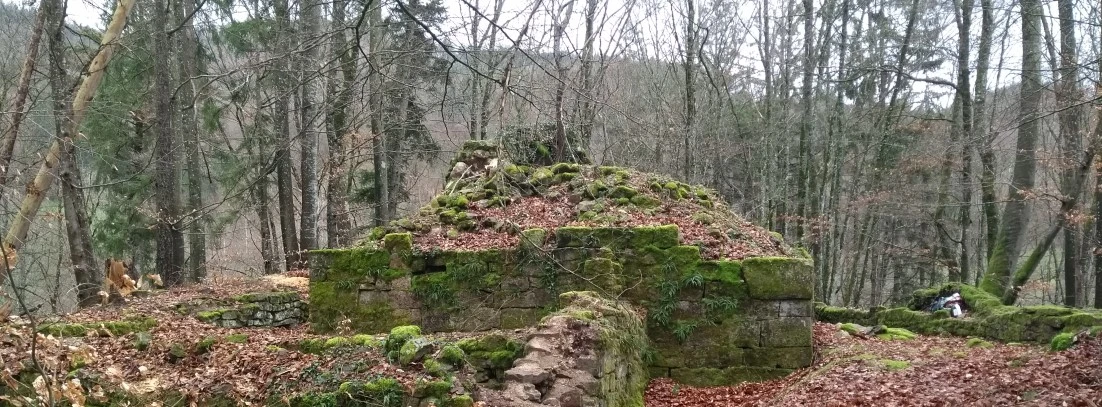



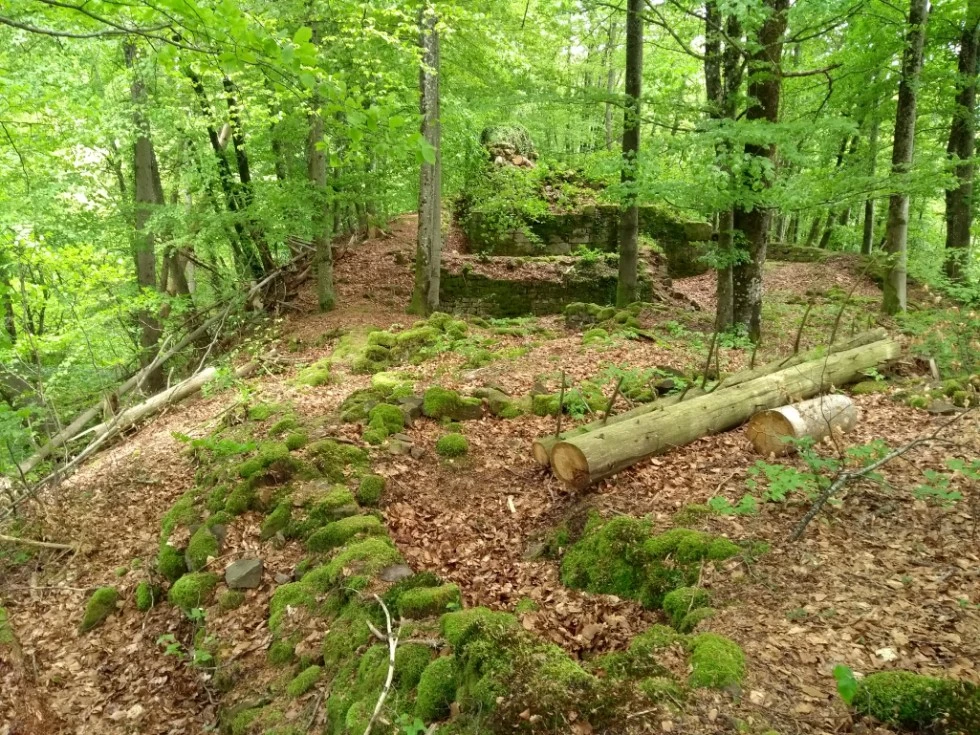
 View across the castle grounds to the east: Remains of the curtain wall to the front left, inner buildings and keep in the background. Photo: W. Richter
Existing Situation
The Turmhölzle castle ruins are among the best-preserved castle ruins in the district of Lörrach. It is situated on an oval hilltop at the end of a mountain spur on the southern slope of the Hohe Möhr to the east of the upper village of Raitbach, a district of the town of Schopfheim. The castle ruins occupy almost the entire summit plateau of the hilltop. It extends over approx. 35 metres in an east-west direction and approx. 18 metres at its widest point in a north-south direction. It has a total area of approx. 600 m2.
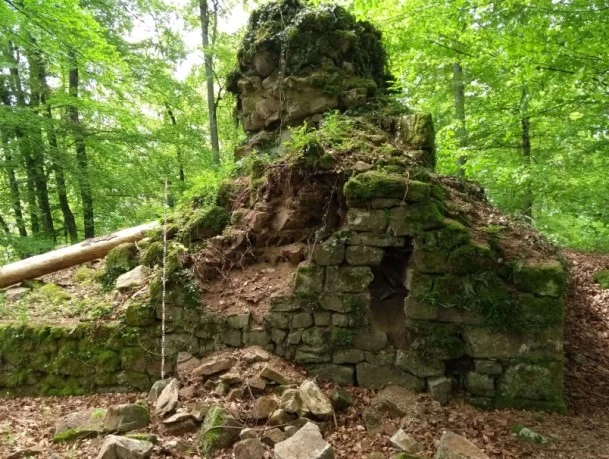
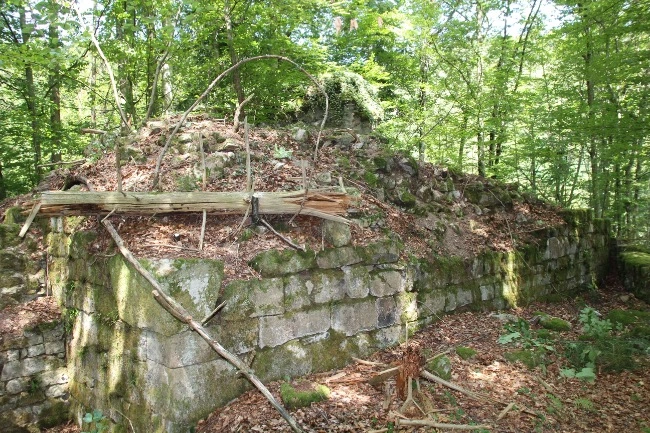 Full width of the keep facing south. Photo: W. Richter

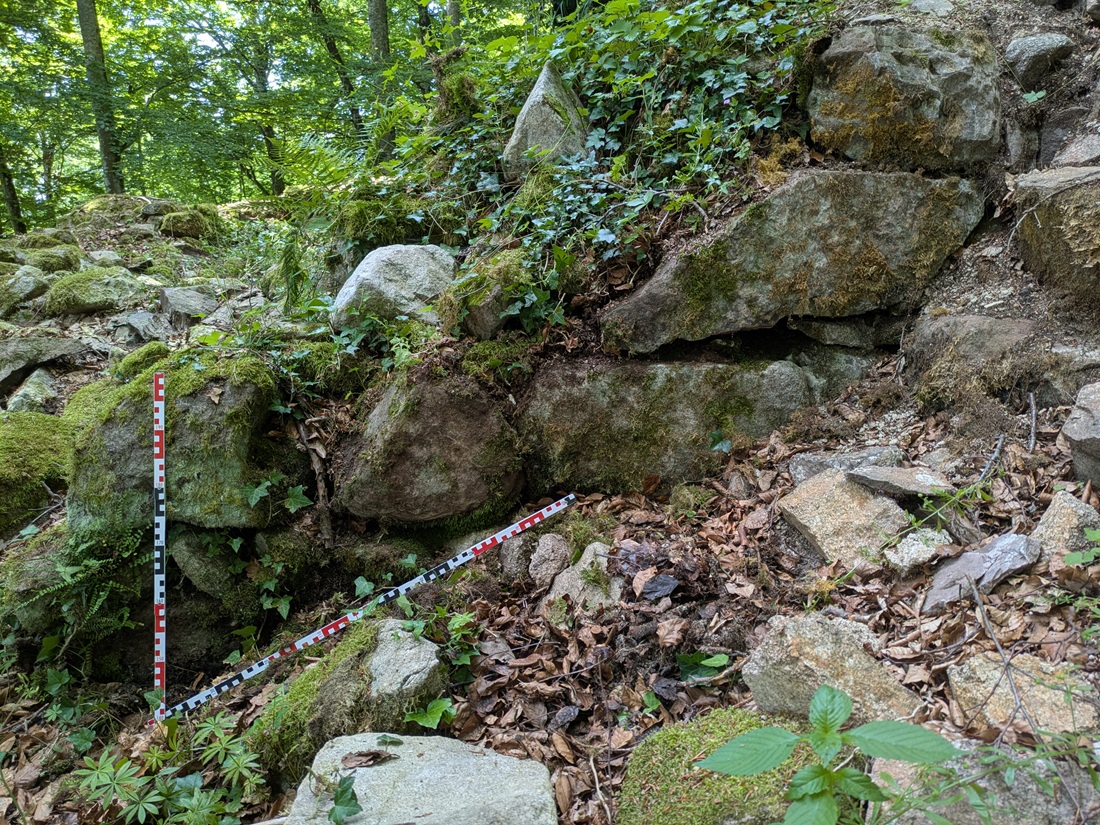
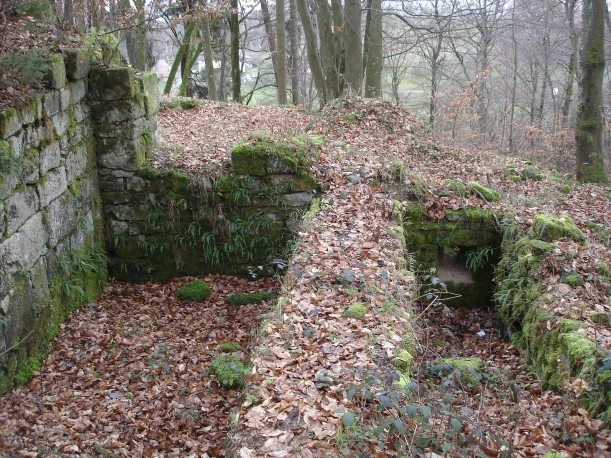 On the left of the picture are the remains of the door/threshold to the first floor of the palace. View from inside the palace. The keep wall on the left edge of the picture. Photo: W. Richter
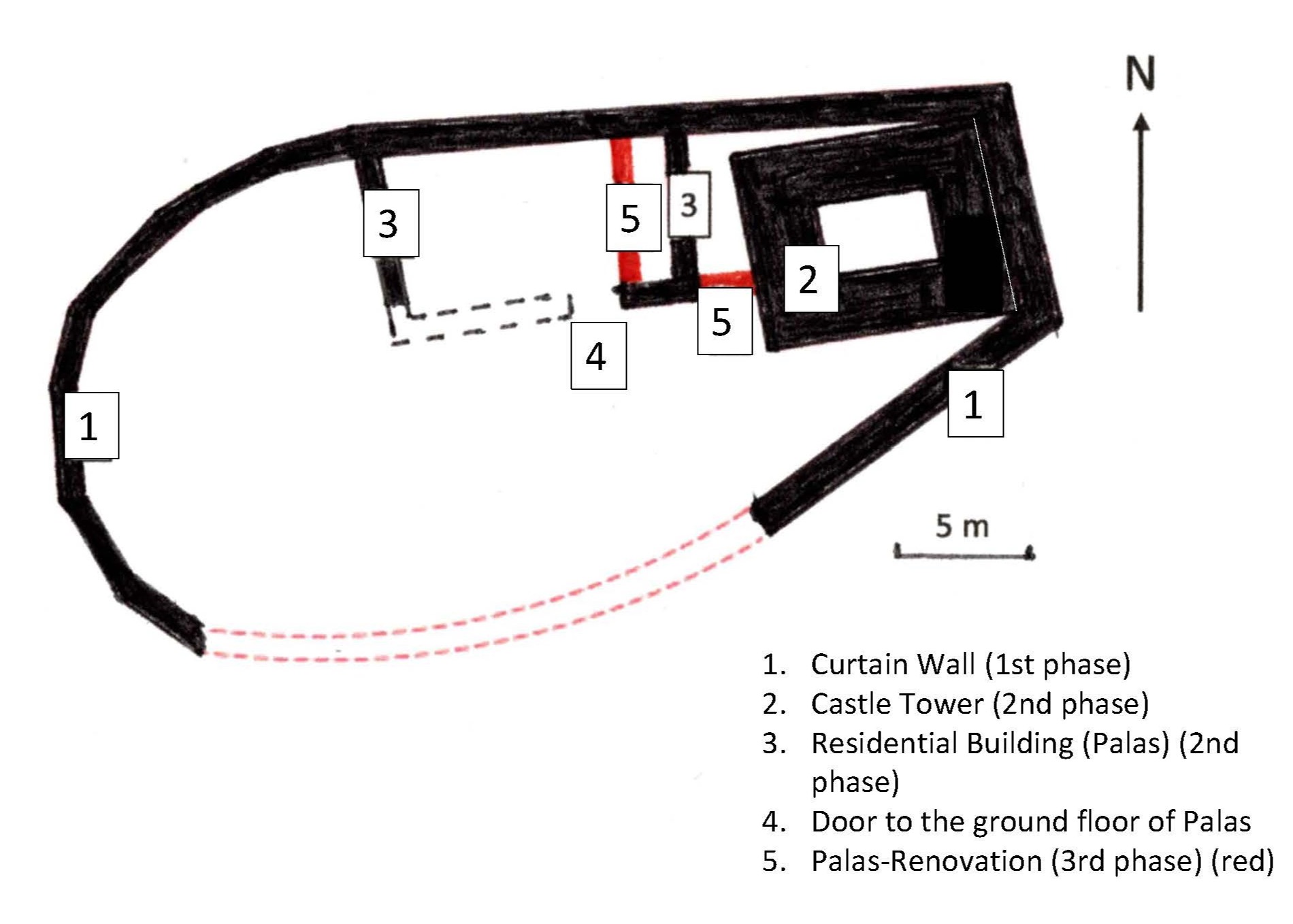 Ground plan of the castle ruin, GPS survey: Stadtmuseum Schopfheim, drawing of the ground plan W. Richter
1st construction phase
The curtain wall (1) was built at the beginning of construction and is between 0.8 and 1.2 metres thick. It was excavated on the east and north sides of the castle in 1981. The outer face of the curtain wall is constructed in hammer-dressed coursed masonry. In the west, the curtain wall can be seen along the edge of the summit plateau, partly due to the moss-covered stones. On the south side, the course of the curtain wall is largely unclear, as this area has not yet been archaeologically investigated. The castle gate, whose location is still unknown, is also thought to be in this area.
2nd construction phase
In the eastern part of the castle grounds are the remains of the rectangular castle tower/keep (2) with a floor area of 9.5 x 7.5 m and walls approximately 2.5 m thick. The keep is directly adjacent to the castle's curtain wall on the eastern side. The exterior of the keep is constructed in carefully dressed ashlar of varying size with smoothed faces (flat ashlars), giving the tower a representative appearance. Only on the eastern side, where the keep abuts the curtain wall, were simple dressed stones used. The use of flat ashlars in the construction of keeps is largely confined to early castles, as by the late 12th century bossed ashlar became the prevailing technique in keep construction.
Adjacent to the keep on the west side are the remains of what is believed to be the main (residential) building (palas), the palas (3) of the castle. Two construction phases can be distinguished in the palas: in the initial construction phase, the palas was separate from the keep. The gate to the ground floor of the palas (4) is still visible.
3rd construction phase
The palas was extended and rebuilt in a later construction phase. The eastern wall from the initial construction phase was demolished down to the ground floor and new walls (5) were erected (red in the plan). The palas was thus extended and reached as far as the keep. The upper edges of the wall remains in the area of the extension (5) correspond approximately to the upper edge of the ground floor. Directly next to the keep are the remains of a door that led to the first floor of the extended palas. The door was probably accessible via a wooden staircase.
The buildings in the western and southern part of the castle are unknown, as this part of the castle grounds has not yet been archaeologically investigated.
Ditches and ramparts are visible around the hilltop. To the east, the hilltop is separated from the rest of the spur by a neck ditch. To the north and west, the hilltop is protected by a ring ditch with a partially polished rampart in front of it.
 View of St. Blasien Abbey around 1562. From L. Schmieder: Das Benediktinerkloster St. Blasien. Augsburg 1929. Fig. 17., Public domain, Link
History
No direct historical information about the castle has yet been found. The name "Turmhölzle" is not the original name of the castle in the Middle Ages. "Fernegg" or "Farnegg" has been suggested as the original castle name on the basis of field names in property descriptions of the monastery of St. Blasien, which had estates in Raitbach (Schubring 1986).
As there are no historical records, the castle's construction history can only be deduced from archaeological findings. Examination of the ruins has shown that the castle's construction history comprises three periods:
Period 1
The castle was initially built as a so-called curtain wall castle, i.e. it did not have a castle tower. The buildings within the cuetain wall from this phase have not yet been archaeologically recorded. Beam holes in the curtain wall indicate a larger building in the north-east corner of the castle. Based on findings in contemporary castles in north-western Switzerland, the buildings may have been constructed of wood or half-timbered. The castle was probably built in the 11th or early 12th century. If further investigations confirm that it was built in the 11th century, the Lords of Waldeck may have been the builders.
The construction of early castles as curtain wall castles does not seem to be unusual in the region. The absence of a tower is typical of early castles in the canton of Aargau (Frei 2023). In other areas, however, the residential tower seems to have been the preferred design in the 11th century. A study of castles from this period (the Salian period) in Hesse, Rhineland-Palatinate and Saarland showed that ‘around 80% of all early noble castles examined had a more or less imposing stone or wooden tower’ (Böhme 1991).
Period 2
In a second phase of construction, the keep and a stone main building (palas) were erected. The masonry of the keep indicates that it was built in the 12th century (Meyer 1981). With these changes, the Turmhölzle castle corresponded to the image of ‘classical’ noble castles with a keep and separate residential building, which began to appear in the second half of the 12th century (Biller 1998). The castle was probably rebuilt by a ministerial of the monastery of St. Blasien to protect the monastic lordship in this area. Raitbach belonged to the Fahrnau-Raitbach estate of the monastery of St. Blasien (Schubring 2000).
Period 3
The palace building was rebuilt and extended towards the keep (see also the castle floor plan).
More precise information about the end of the castle is lacking. The pottery found suggests that the castle was abandoned as early as the first half of the 13th century. It remains unclear whether the charred pieces of clay found during the excavation indicate that the castle was destroyed by fire. However, it is also possible that the end of the castle is linked to changes in ownership in Raitbach. The Lords of Stein (Herren von Stein) gained influence in Raitbach and built the nearby Neuenstein Castle (now the Ruine Burgholz), which was first mentioned in documents in 1283 (Schubring 2000).
Excavation of the castle
In 1981, the eastern part of the castle with the keep was excavated by school groups under the guidance of archaeologists on the initiative of the town of Schopfheim. Most of the remains of the walls now visible came to light during this excavation.
In 1982, the State Monuments Office stopped further excavations before the excavated walls were properly conserved and secured. No conservation of these walls has yet taken place.
As the excavation of the castle could not be continued, many questions about the layout, the building history and the beginning and end of the castle remained unanswered.
Endangerment of the castle ruins
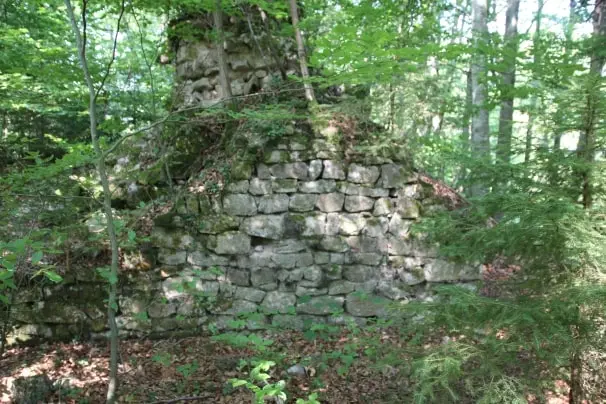
 Remains of the ring wall after the reversible reconstruction in October 2024. Photo: W. Richter
The sections of wall uncovered during the 1981 excavation were not preserved at the time. In the meantime, the exposed walls have begun to decay. In 2022, for example, there was a major wall collapse on the east side of the curtain wall. Significant decay is also visible on parts of the interior buildings.
It is to be expected that without conservation of the walls, the decay will continue and could lead to the long-term loss of this remarkable castle ruin.
How to get there

Literature
Thomas Biller, Die Adelsburg in Deutschland / Entstehung-Gestalt-Bedeutung, München, 1998, S. 134 Digitalisat der UB Heidelberg, Th.B.
Horst Wolfgang Böhme, Burgen der Salierzeit in Hessen, in Rheinland-Pfalz und im Saarland, in: Horst Wolfgang Böhme (Hg.), Burgen der Salierzeit/Teil 2/In den südlichen Landschaften des Reiches, Sigmaringen 1991, S. 69 Digitalisat der UB Heidelberg, H.W.B.
Peter Frey, Die Burgen des Kantons Aargau / Mittelalterliche Adelssitze, Brugg 2023, S. 29 Digitalisat der UB Bern, P.F.
Werner Meyer, Burgen von A bis Z – Burgenlexikon der Regio, Basel 1981. S. 35
Klaus Schubring, Ein älterer Name für das Turmhölzle in Raitbach – Eine Ruine gibt Fragen auf, in: Jahrbuch ´86 Stadt Schopfheim, S. 62-69.
Klaus Schubring, Bauern, Mönche und Adlige, in: Schopfheim - Natur, Geschichte, Kultur, Schopfheim, 2000. S. 101-120.
C.A. Müller, Burgen und Schlösser, in: Das Markgräflerland, Jahrgang 4/35, Sonderheft 1973. S. 61 Digitalisat der UB Freiburg, C.A.M.